Capabilities
The language barrier problem
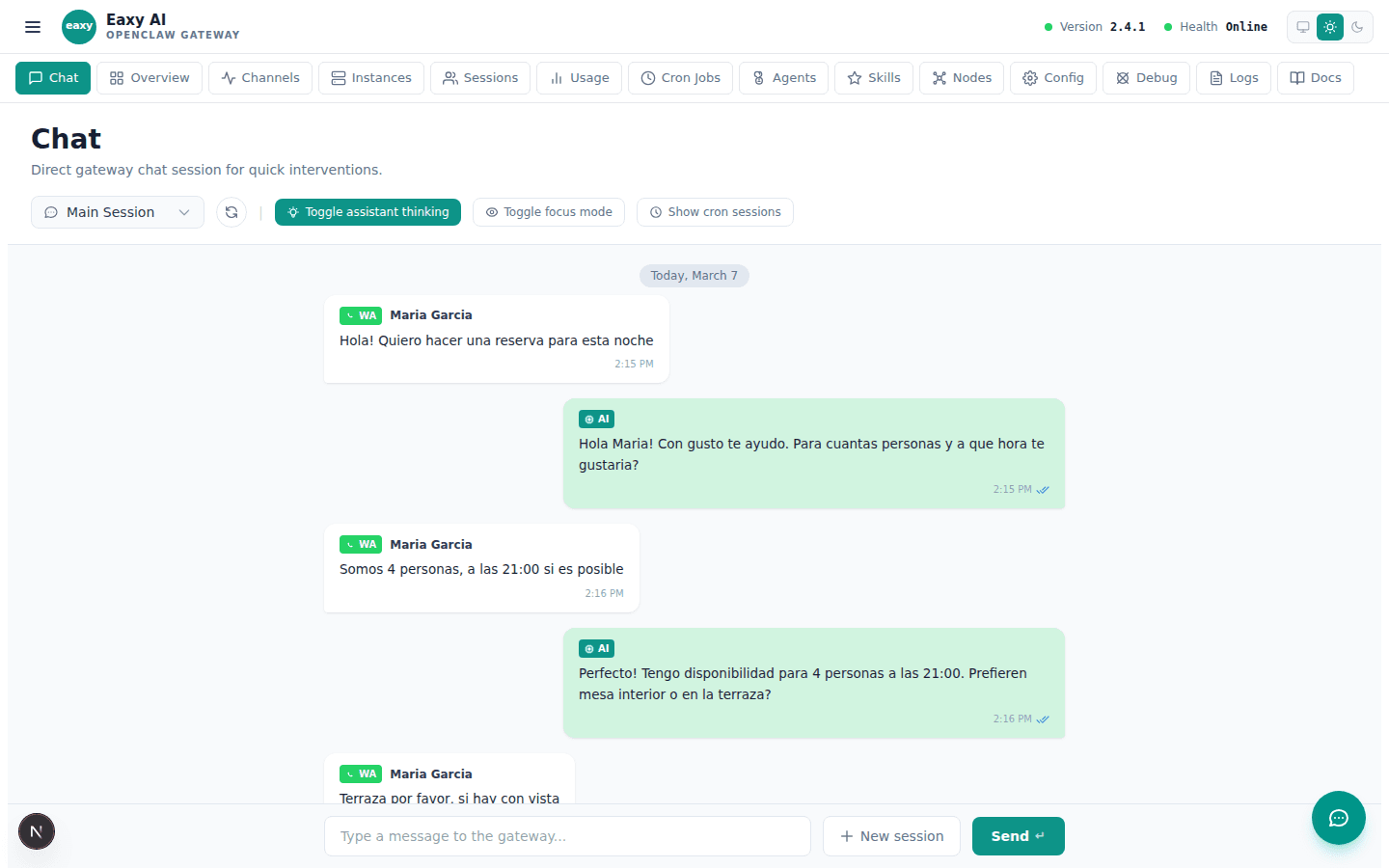
Most businesses lose customers simply because they cannot respond in the language the customer chose to write in. A hotel in Barcelona receives inquiries in Spanish, English, French, German, and Japanese. A restaurant in Miami gets messages in English, Spanish, Portuguese, and Haitian Creole. Traditionally, handling this requires either multilingual staff — which is expensive and hard to find — or translation tools that add friction and delay to every conversation. The result is that businesses either ignore messages in languages they do not speak, respond with awkward machine translations that damage credibility, or funnel everyone into a single language that alienates a large portion of their customer base. Eaxy solves this by detecting the customer language from the first message and generating the entire response in that language while preserving the business knowledge, tone, and escalation rules that were configured in the primary language. The customer never sees a language toggle, never gets asked to switch languages, and never receives a response that feels translated. From their perspective, they are simply talking to a business that speaks their language fluently. This capability is especially powerful for businesses in multilingual regions, tourist destinations, and international e-commerce where the customer base spans multiple language groups and hiring native speakers for every language is simply not feasible.
Capabilities
How language detection works
Eaxy uses the AI model underlying the assistant to detect the language of each incoming message in real time. Unlike rule-based systems that rely on browser settings or IP geolocation, Eaxy reads the actual text and identifies the language with high accuracy even when the message contains mixed languages, slang, abbreviations, or emojis. This matters because real customer messages are rarely written in perfect formal language. A customer might write "Hola, do you have availability tomorrow?" mixing Spanish and English in a single sentence. Eaxy interprets the dominant language and intent and responds accordingly — in this case likely in the language that carries the core question. The detection happens on every message, not just the first one, which means the assistant adapts if a customer switches languages mid-conversation. All of this happens without any configuration from the business owner. The knowledge base, FAQs, pricing information, and business rules are provided once in the primary language, and the AI generates culturally appropriate responses in the detected language. The business owner can optionally provide translations for critical terminology — product names, service descriptions, legal disclaimers — to ensure maximum accuracy for domain-specific vocabulary. But even without these optional translations, the quality of multilingual responses is remarkably high because the underlying model has been trained on extensive multilingual data.
Capabilities
Business impact and use cases
The business impact of multilingual support extends far beyond convenience. For a hotel, being able to respond to a Japanese traveler in Japanese within seconds can be the difference between a direct booking and a lost guest who books through an OTA instead. For an e-commerce store shipping internationally, answering product questions in the customer native language increases conversion rates by fifteen to thirty percent compared to forcing customers to interact in a language they are less comfortable with. Tourism businesses — tours, restaurants, rental services — benefit enormously because their customer base is inherently international and the window of opportunity for each interaction is short. A tourist deciding where to eat dinner will not wait for a translated response; they will simply message the next restaurant on the list. Service businesses in multilingual cities like Miami, Montreal, Brussels, or Singapore can serve their entire customer base without maintaining separate teams for each language. The assistant handles Spanish inquiries with the same quality as English ones, and French questions receive the same attention as Dutch ones. This creates a consistent customer experience regardless of language, which strengthens brand perception and customer loyalty. When evaluating ROI, consider not only the conversations that are now handled automatically but also the conversations that were previously lost entirely because the business could not respond in the customer language at all.