AI Agent for Dental Clinics: Automate Appointments, Follow-ups & Patient FAQs
Learn how dental clinics use AI agents to reduce no-shows by 35%, handle 80% of patient inquiries automatically, and keep the front desk focused on in-office care instead of endless phone calls.
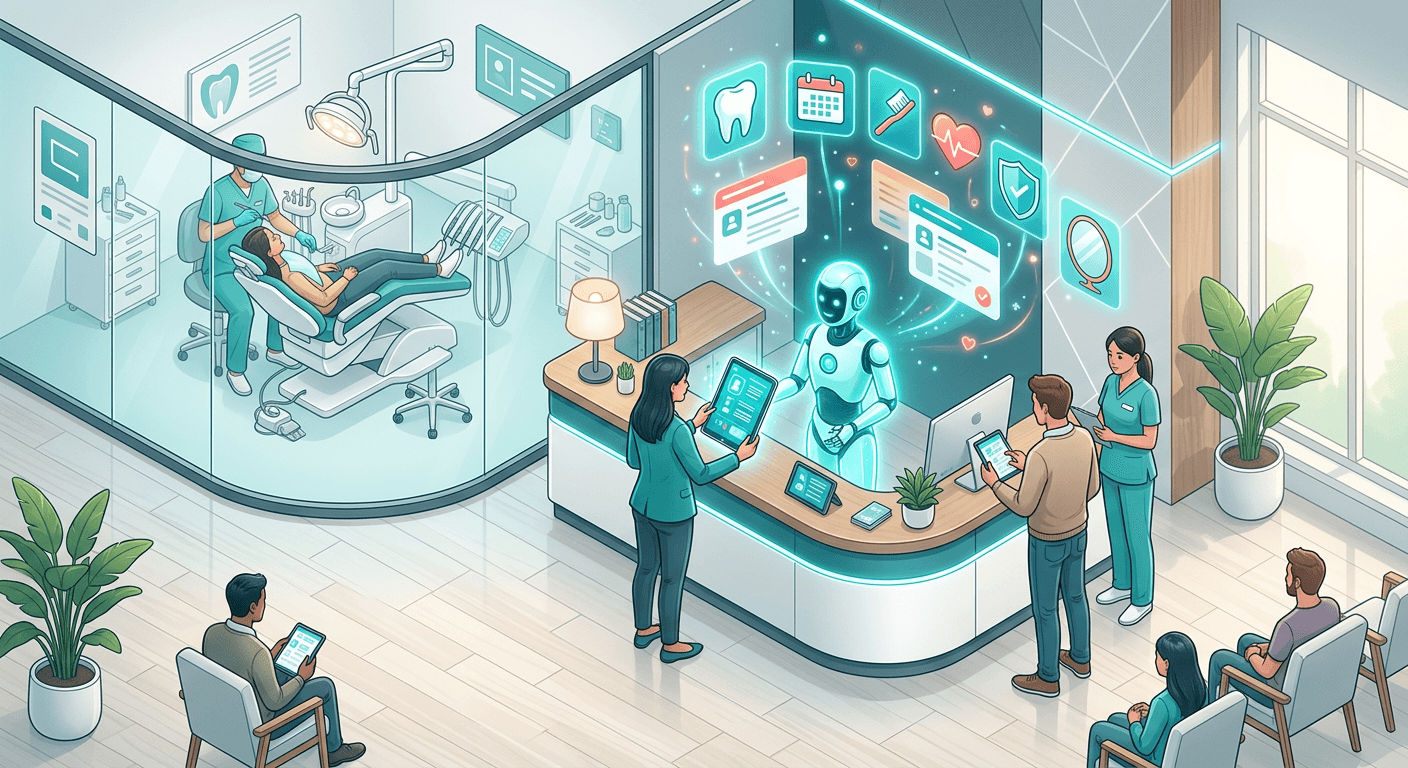
The average dental clinic loses between 20 and 35 potential appointments every week to missed phone calls. Staff are busy chairside, the phone rings during a procedure, and by the time someone calls back the patient has already booked with a competitor down the street. Meanwhile, after-hours inquiries pile up in voicemail boxes that nobody checks until 9 AM the next morning. These are not hypothetical problems. A 2025 survey by the Dental Economics Research Group found that 62% of dental practices cite phone management as their single biggest administrative bottleneck.
AI chatbots built for dental clinics solve this by acting as a tireless, always-available digital receptionist. They answer patient questions on your website, WhatsApp, Instagram, or SMS, schedule and confirm appointments, send follow-up reminders, and handle the repetitive insurance eligibility questions that consume hours of staff time every week. The best part: they do all of this without putting a single patient on hold. In this guide, we will walk through exactly how dental-specific AI chatbots work, what ROI you can realistically expect, how to stay HIPAA-compliant, and how to get one running for your practice in days rather than months.
Why Dental Clinics Need AI Chatbots More Than Most Industries
Dental practices operate in a unique environment that makes them especially well-suited for AI automation. Unlike general retail or e-commerce, dental clinics deal with a finite set of services (cleanings, fillings, crowns, implants, orthodontics, emergencies), predictable patient questions, and appointment-driven revenue. Every empty chair is lost revenue that cannot be recovered. A single missed hygiene appointment costs the average practice $150 to $250, and a missed implant consultation can mean $3,000 to $5,000 in lost treatment revenue.
- High call volume with repetitive questions: 70% of inbound calls are about the same 10-15 topics (hours, insurance accepted, appointment availability, cost estimates, parking, emergency protocols).
- After-hours demand: 43% of dental appointment requests happen outside business hours, according to PatientPop data. Without an AI chatbot, those patients either leave a voicemail (which 60% will not do) or move on.
- No-show epidemic: The dental industry averages a 15-20% no-show rate. Automated reminders via chatbot reduce this by 35% on average by sending confirmation sequences at 72 hours, 24 hours, and 2 hours before the appointment.
- Staff burnout: Front desk teams juggle check-ins, insurance verification, phone calls, and scheduling simultaneously. Offloading the phone and messaging channels to an AI chatbot lets them focus on the patient standing in front of them.
- Competitive pressure: Patients now expect instant responses. A Salesforce study found that 64% of consumers expect real-time interaction regardless of the channel. Clinics that respond within 5 minutes are 21x more likely to convert a lead than those that respond within 30 minutes.
Dental clinics that deploy AI chatbots report an average 28% increase in new patient bookings within the first 90 days, primarily from capturing after-hours and missed-call inquiries that previously went unanswered.
What a Dental AI Chatbot Actually Does (With Real Scenarios)
A dental AI chatbot is not a glorified FAQ page. It is a conversational agent trained on your specific practice information -- your services, pricing, insurance panels, office hours, provider bios, and scheduling rules. It understands context, handles multi-turn conversations, and takes action (like booking an appointment or sending a form link). Here are the core workflows it automates:
1. Intelligent Appointment Scheduling
Scenario: It is 9:47 PM on a Tuesday. Maria searches "dentist near me" on her phone, finds your website, and clicks the chat widget. She types: "I need a cleaning, do you have anything this week?" The AI chatbot checks your live calendar integration, finds three available hygiene slots, and presents them. Maria picks Thursday at 2 PM. The chatbot collects her name, phone number, insurance info, and sends her a confirmation text with a link to your new patient forms. Total time: 90 seconds. No staff involvement. Your front desk sees the confirmed appointment when they arrive at 8 AM Wednesday morning.
This is not futuristic. Clinics running AI chatbots with calendar integrations (via tools like Google Calendar, Dentrix, Eaglesoft, or Open Dental APIs) are doing this today. The chatbot can also enforce scheduling rules -- for example, only allowing hygiene appointments with certain providers, blocking out lunch hours, or requiring a minimum 48-hour lead time for new patient exams.
2. Automated Appointment Reminders and No-Show Recovery
The chatbot sends a multi-step reminder sequence: a friendly message 72 hours before ("Looking forward to seeing you Thursday at 2 PM! Reply YES to confirm or RESCHEDULE to pick a new time"), a same-day morning reminder, and a 2-hour heads-up. If the patient replies "reschedule," the chatbot immediately offers alternative slots. If a patient no-shows, the chatbot sends a follow-up within 2 hours: "We missed you today! Would you like to rebook? Here are our next available times." This automated recovery loop alone recaptures 15-20% of no-shows that would otherwise be permanently lost.
3. Patient FAQ Handling
Dental clinics receive the same questions hundreds of times per month. An AI chatbot handles these instantly without any staff involvement:
- "Do you accept Delta Dental / Cigna / MetLife?" -- The chatbot checks your insurance panel list and responds with a definitive yes or no, plus next steps for out-of-network patients.
- "How much does a crown cost?" -- The chatbot provides a price range based on your fee schedule and explains that a precise quote requires an exam.
- "I have a toothache, can I come in today?" -- The chatbot identifies this as an emergency, checks for same-day openings, and escalates to staff via text or email if none are available.
- "What are your hours?" -- Instant response with current hours, holiday schedule adjustments, and a link to book.
- "Do you offer payment plans?" -- The chatbot explains your CareCredit, Sunbit, or in-house financing options with application links.
- "Is teeth whitening safe during pregnancy?" -- The chatbot provides a medically reviewed response and recommends consulting with the dentist during the next visit.
Train your chatbot with at least 50 real patient questions from your call logs and email inbox. The more specific the training data, the more accurate and trustworthy the responses. Generic chatbots that give vague answers erode patient confidence.
4. Post-Treatment Follow-ups
After a procedure, the chatbot automatically sends a follow-up message: "Hi Maria, how are you feeling after your filling today? Here are your post-care instructions: [link]. If you experience severe pain, swelling, or bleeding, reply URGENT and we will connect you with Dr. Patel right away." This does three things: it improves patient satisfaction (they feel cared for), it reduces unnecessary post-op calls (because the instructions are proactively delivered), and it catches genuine complications early by routing urgent replies to the dentist.
5. Recall and Reactivation Campaigns
Every dental practice has hundreds of "lapsed" patients who have not visited in 6, 12, or 18+ months. An AI chatbot can run automated reactivation campaigns via SMS or WhatsApp: "Hi David, it has been 8 months since your last cleaning at Bright Smile Dental. Dr. Patel recommends a cleaning every 6 months. Want to book? Here are this week's openings." Clinics using automated recall see a 22% reactivation rate compared to 8% for postcards and 12% for manual phone calls.
The ROI Math: What Dental AI Chatbots Actually Save You
Let us run the numbers for a mid-sized dental practice (3 operatories, 2 dentists, 2 hygienists, seeing ~40 patients per day):
- Missed calls recovered: 15 calls/week x 30% conversion rate x $200 avg first-visit value = $900/week or $46,800/year in new patient revenue.
- No-show reduction: 35% fewer no-shows x 8 no-shows/week x $175 avg appointment value = $490/week or $25,480/year in recovered revenue.
- After-hours bookings: 10 after-hours inquiries/week x 40% booking rate x $200 avg value = $800/week or $41,600/year.
- Staff time saved: 2.5 hours/day of phone time redirected to patient care and treatment coordination = 1 fewer part-time receptionist needed = $18,000-$24,000/year in salary savings.
- Recall reactivation: 20 reactivated patients/month x $250 avg visit value = $5,000/month or $60,000/year.
- Total estimated annual impact: $191,880 to $197,880 in combined revenue recovery and cost savings.
Even conservative estimates show dental AI chatbots paying for themselves within 2-3 weeks. A typical AI chatbot platform costs $99-$299/month. Compare that to the $3,800-$16,500 in monthly revenue impact outlined above. That is a 12x to 55x return on investment.
HIPAA Compliance: What Dental Clinics Must Know
Any dental practice deploying an AI chatbot that handles patient information must ensure HIPAA compliance. This is non-negotiable. A HIPAA violation can result in fines from $100 to $50,000 per incident, up to $1.5 million per year for repeat violations. Here is what you need to verify before deploying any chatbot solution:
Business Associate Agreement (BAA)
Your chatbot vendor must sign a BAA before any patient data flows through their system. This is required by law. The BAA specifies how the vendor will protect PHI (Protected Health Information), what happens in a breach, and the vendor's responsibilities. If a vendor refuses to sign a BAA, walk away immediately. No exceptions.
Data Encryption and Storage
- All data must be encrypted in transit (TLS 1.2 or higher) and at rest (AES-256).
- Chat transcripts containing PHI must be stored in HIPAA-compliant infrastructure (AWS, GCP, or Azure with BAA-covered services).
- Patient data should never be used to train the AI model unless the patient has given explicit written consent.
- Implement automatic data retention policies: purge chat transcripts after a defined period (e.g., 7 years per dental record retention requirements, or shorter for non-clinical conversations).
- The chatbot should never display full SSNs, insurance IDs, or medical record numbers in chat. Use partial masking (e.g., '***-**-1234').
Access Controls and Audit Trails
The platform must support role-based access controls (RBAC) so that only authorized staff can view patient chat transcripts. Every access to patient data must be logged in an audit trail. The chatbot should also implement session timeouts -- if a patient steps away mid-conversation, the session should expire after 15 minutes and require re-identification to resume.
Never deploy a consumer-grade chatbot (like a basic ChatGPT wrapper) for patient-facing dental communication. Consumer AI tools are explicitly excluded from HIPAA coverage. Only use platforms that are purpose-built for healthcare and offer signed BAAs, SOC 2 Type II compliance, and HIPAA-compliant hosting.
Choosing the Right Channels for Your Dental Chatbot
Not every channel works equally well for dental practices. Here is a breakdown based on what we see performing best:
- Website chat widget: The highest-intent channel. Patients visiting your website are actively looking for a dentist. Conversion rates from website chat are 3-5x higher than contact forms. Deploy your chatbot here first.
- SMS/Text messaging: The best channel for appointment reminders, confirmations, and recall campaigns. 98% open rate within 3 minutes. Patients overwhelmingly prefer texting over calling for appointment management.
- WhatsApp: Essential for practices serving Hispanic, Brazilian, and international communities. WhatsApp is the default communication channel in Latin America and many parts of Europe and Asia.
- Instagram DMs: Increasingly important for cosmetic dentistry practices (veneers, whitening, Invisalign). Patients researching cosmetic procedures often reach out via Instagram after seeing before-and-after photos.
- Google Business Messages: Allows patients to message you directly from your Google Maps listing. High intent, but lower volume than website chat.
- Phone (voice AI): Emerging technology that answers phone calls with an AI voice agent. Best used as a fallback when staff cannot answer, not as a full replacement for human phone interaction.
Implementation: Getting Your Dental AI Chatbot Live in 5 Steps
Deploying a dental AI chatbot does not require months of development or a six-figure IT budget. With modern platforms, most practices go live within 3-5 business days. Here is the process:
- Step 1 -- Gather your practice information: Compile your service list, fee schedule, insurance panels, office hours, provider bios, post-care instructions, and your top 50 most-asked patient questions. This is the knowledge base your chatbot will draw from.
- Step 2 -- Choose your platform and channels: Select a HIPAA-compliant AI chatbot platform that supports the channels your patients use most. Prioritize website chat and SMS for the initial launch.
- Step 3 -- Configure scheduling rules: Connect your practice management system (Dentrix, Eaglesoft, Open Dental) or calendar. Set rules for appointment types, provider availability, buffer times, and new patient vs. existing patient flows.
- Step 4 -- Test with real scenarios: Before going live, run 30-50 test conversations covering appointment booking, insurance questions, emergencies, and edge cases. Have your front desk team review the responses for accuracy.
- Step 5 -- Launch and iterate: Go live on your website first. Monitor conversations daily for the first two weeks. Refine responses where the chatbot struggles. Expand to SMS and WhatsApp once website performance is dialed in.
Common Mistakes Dental Practices Make With AI Chatbots
- Making the chatbot too robotic: Patients want a conversational, warm experience. Configure the chatbot's tone to match your practice brand. If your practice is family-friendly and casual, the chatbot should be too.
- Not having a human handoff protocol: The chatbot should seamlessly transfer to a human when it detects complex clinical questions, upset patients, or situations it is not trained to handle. Never let a patient feel trapped in a bot loop.
- Ignoring analytics: Track key metrics weekly -- conversations started, appointments booked, questions unanswered, handoffs to staff, patient satisfaction scores. Use this data to continuously improve the chatbot.
- Launching on too many channels at once: Start with one or two channels, optimize, then expand. Launching everywhere simultaneously spreads your attention too thin during the critical learning phase.
- Forgetting to update the knowledge base: When you add a new service, change hours, or update insurance panels, the chatbot needs to know. Assign one team member to be the chatbot's content owner.
“We were skeptical at first, but within the first month our chatbot booked 47 appointments that would have otherwise been missed calls. Our front desk went from drowning in phone calls to actually having time to greet patients properly when they walk in.”
The Future: What Is Coming for Dental AI in 2026 and Beyond
AI chatbots for dental clinics are evolving rapidly. Here is what to expect in the next 12-18 months: voice AI agents that answer phone calls indistinguishably from human receptionists, AI-powered insurance verification that checks eligibility in real time during the chat conversation, predictive scheduling that identifies optimal appointment times based on a patient's history and no-show risk score, and integration with clinical AI tools that can analyze X-rays shared via chat to provide preliminary assessments before the patient even arrives. The practices that adopt AI now will have a 12-18 month head start in training their systems and building patient trust with automated communication.
Ready to Stop Losing Patients to Missed Calls?
Every day without an AI chatbot is another day of missed calls, lost appointments, and staff stretched too thin. The math is clear: for less than the cost of one hygiene appointment per month, you can deploy an AI concierge that works 24/7, never calls in sick, and captures every single patient inquiry across every channel.
Eaxy.ai lets you deploy a HIPAA-aware AI chatbot for your dental practice in minutes, not months. Connect your website, WhatsApp, and SMS in one dashboard. Review pricing and launch the right workspace for your practice.
Deploy Your Dental AI Chatbot NowNext step
Turn this research into a deployment plan
If this post matches a workflow you want to automate, the next buyer questions are usually pricing, competitive fit, onboarding details, and whether Eaxy already maps to your industry.
Buyer resources
FAQ for buyers
Review setup, handoff, channels, and deployment answers before you talk to sales.
Security overview
Check isolation, encryption, and trust details for buyer due diligence.
AI receptionist pricing
Understand what changes cost before you choose Starter, Pro, or Business.
WhatsApp automation pricing
Compare WhatsApp chatbot cost drivers, setup requirements, and managed deployment scope.
More from the Blog
How AI Agents Are Replacing Traditional Call Centers (And Why That's Good for Everyone)
Call centers spend 70% of their budget on repetitive inquiries. AI agents handle those instantly, 24/7, at a fraction of the cost — while human agents handle the complex cases that actually matter.
AI Agents for Salons and Spas: The Complete Automation Guide for 2026
Salons lose 30% of booking inquiries to missed calls and slow responses. AI agents book appointments, send reminders, recommend services, and rebook clients automatically — working 24/7.
AI Agents for Home Service Businesses: Plumbers, Electricians, HVAC, and Contractors
Home service companies lose 40% of urgent repair calls because customers cannot reach them during the job. AI agents answer every call, qualify leads, and schedule jobs — even at 11 PM.